|
Using Artificial
Intelligence in Human Resources
By
Jeanne
Meister, Founding Partner, Future
Workplace
 Whether
you know it or not, you are using artificial
intelligence (AI) every day. You may be
listening to a personalized playlist on
Spotify or using Waze to navigate your route
in traffic. Companies like these have developed
a highly personalized user experience powered
by AI technology. Whether
you know it or not, you are using artificial
intelligence (AI) every day. You may be
listening to a personalized playlist on
Spotify or using Waze to navigate your route
in traffic. Companies like these have developed
a highly personalized user experience powered
by AI technology.
While AI and machine learning have become
a part of our everyday life, there is a
gap in how we are using the technology in
the workplace. Future
Workplace and Oracle
partnered on research to explore how HR
leaders are using AI in the workplace. The
study, polling 1,320 US HR leaders, identified
a large gap between the way people are using
AI at home and at work. While 70% of people
are using some form of AI in their personal
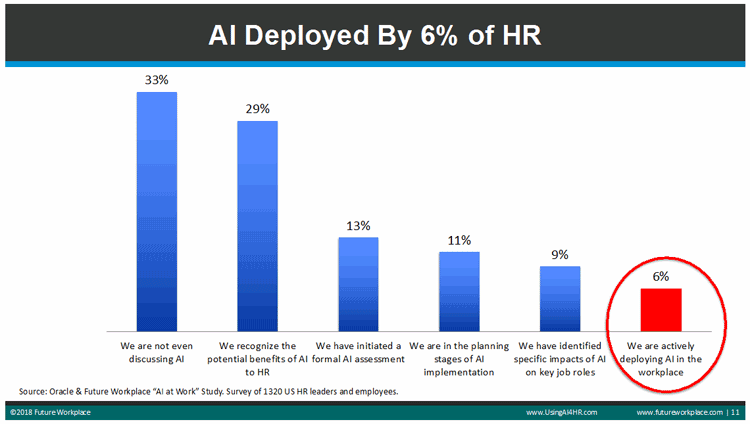
life, only 6% of HR professionals are actively
deploying AI in the workplace and 33% are
not even discussing using AI at work. The
range of answers to how HR leaders are deploying
AI at work is depicted in the bar chart
below.
The other key finding is that organizations
are not doing enough to prepare the workforce
for using AI at work. Almost all (90%) of
HR leaders in our sample are concerned they
will not be able to adjust to the rapid
adoption of AI as part of their job. To
make matters worse, they are not currently
empowered to address an emerging AI skills
gap in their organization.
While most HR leaders are still at the
early stages of deploying AI in the workplace,
the future of work involves working side
by side with AI and/or “digital colleagues,”
according to Gartner's
recent prediction that by
the year 2022, one in five employees
will be working alongside a digital assistant.
While AI has the potential to automate routine
tasks in jobs, the key benefit is to use
AI to augment human capabilities by delivering
predictive insights at key moments and freeing
up time for humans to add greater value
and deliver a more compelling customer and
employee experience. Here are five
ways CHROs and their teams can begin their
journey to deploy AI in the workplace.
1. Be curious about what AI is
and how it can impact you,
your team and your HR function
First, be clear on the definition of artificial
intelligence and machine learning terms
that you will be reading quite a lot about.
My "working definitions” are
these:
Artificial intelligence is the umbrella
term and refers to computer systems performing
tasks that exhibit "human-like"
intelligence.
Machine learning is a
subset of artificial intelligence, designed
to make algorithms smarter as they learn
from human activity and behaviors.
Next, start researching AI tools you can
use in your daily work life to help you
work smarter. For example, consider trying:
Paysa,
a site that uses machine learning to provide
salary information and career insights for
job seekers and employers;
X.ai,
a virtual AI powered personal assistant
to schedule your meetings which is programmed
to learn from each interaction with you;
Textio,
an AI powered site which helps your recruiting
team improve the text of job descriptions,
attracting a more diverse talent pool.
These are great ‘gateway’ products
that will help you better understand how
AI can improve your personal productivity
and impact finding top talent for your company.
2. Identify the most important
business problems to be solved by using
AI
Before we become enamored with technology
for "technology’s sake,"
identify some key business problems that
can be solved using AI in the workplace
and then start collecting data on the problem
to see how AI might create a different employee
experience. I polled a few of our
clients and one area that came up as well
suited for using AI was improving the experience
of on-boarding for new hire remote employees.
rLoop, a leader in the future of transportation, started using AI for new hire on-boarding by collecting data on new hires’ frequently asked questions. When employees come on board they ask a range of similar questions such as: what projects does rLoop have underway, how do they get started using company online expense reporting and what are the company paid holidays for the current year. Many of the answers to these questions are repetitive, and therefore ideally suited to be handled using AI so the HR team can focus on building deeper relationships with new hires and disseminating the company culture and values.
3. Understand
how machine/human collaboration must occur
at the employee’s moment
of need
Look at the world through the employee's
point of view and employ tools of employee
journey mapping and design thinking to understand
their moments of need and how AI can enhance
this experience. These moments can include
recruiting, on boarding, career development,
performance management and coaching.
Avoid bolt-on efforts of using AI in the
workplace. Rather, what’s needed
is understanding, on a deeply human level,
the current experience of employees and
ways AI can provide insights at the employee's
moment of need.
4. Communicate with employees on
how the organization plans to leverage artificial
intelligence in
the workplace
The benefits to using AI at work are numerous,
from improving the efficiency and effectiveness
of the candidate experience to enhancing
the employee experience and providing employees
greater personalization in developing their
own career path.
But CHROs and their teams must also be aware
of barriers along the journey as HR experiments
with AI. A survey of 3,000 employees across
eight nations conducted by Kronos
Incorporated finds 3 out of
every 5 organizations (58%) have yet to
discuss the potential impact of AI on their
workforce with their employees. However,
two-thirds of employees (61%) say they’d
feel more comfortable if their employer
was more transparent about what the future
may hold for them and share what the company
will be doing to upskill them.
In addition to communicating how the organization will use AI at work, HR leaders must be vigilant about addressing deep-seated employee fears, namely fear of job loss and an uneasiness in learning new skills. All of this points to a close collaboration between CHROs and the corporate communications team to communicate the vision and strategy for using AI in the workplace.
5. Consider artificial intelligence
a business issue, not just an HR issue
The use of AI in the workplace impacts key
processes, workflows and democratizes decision
making among managers and employees. This
means an HR leader must identify a coalition
of stakeholders from a variety of titles,
levels, expertise and geographies to develop
a shared vision for delivering business
results using AI.
As we contemplate the future of HR and
how to integrate AI into the workplace,
standing still is not an option. If we want
our careers in HR to be relevant, I believe
we must understand the power of AI and machine
learning to change, transform and enhance
the employee experience. As Erik Brynjolfsson
and Andrew McAfee, say in their Harvard
Business Review article, "Over
the next decade, AI won’t replace
managers, but managers who use AI will replace
those who don’t.”
About Jeanne Meister
Jeanne Meister is the Founding Partner of Future Workplace, an HR advisory and research firm working with HR leaders to prepare them for what's next in transforming the HR function. Future Workplace has created an online course Using AI 4 HR To Enhance the Employee Experience featuring IBM, GE, Hilton, Intel and others who are using AI and realizing business benefits across the organization.
|

