Crisis Quitters: Why Employees Leave After
Major Life Events and How to Keep Them
By Julie Klappas and Pilar Prinz, Co-Founders, Forwardly
 It started with her quietly removing her wedding ring while in the restroom. It started with her quietly removing her wedding ring while in the restroom.
Sarah*, a senior producer at a global media company, had been holding it together at work for months while her marriage unraveled at home. She still delivered projects on time. She still led her team through high-pressure launches. But behind the scenes, the emotional toll — lunchtime calls with her lawyer, moving into a new apartment, juggling parenting exchanges and homework for her two young kids — was grinding her down.
When she finally gave notice, her manager was stunned. Sarah was not leaving for a bigger title or higher pay. She was leaving because she needed more control over her time. Freelance work, with its uneven but flexible schedule, felt like the only way to keep her career alive while managing her chaotic life.
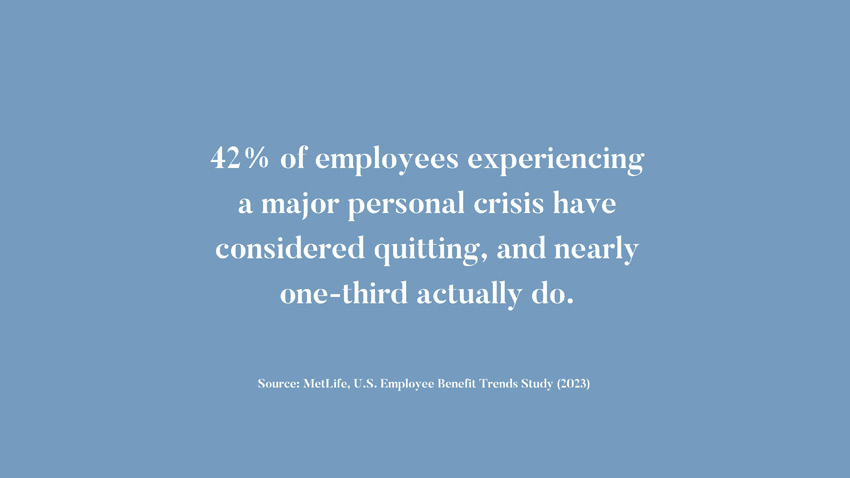
Sarah is not alone. Research shows that 1 in 9 employees going through a divorce will leave their job within a year.1 Add in other upheavals such as the death of a loved one, serious illness or caregiving for an aging parent, and the risk of turnover spikes across industries. A 2023 MetLife study found that 42% of employees experiencing a major personal crisis have considered quitting, and nearly one-third actually do.2
These are not just “one-off” crises. Many workers are part of the sandwich generation, caught between raising children and caring for aging parents. This ongoing strain usually is not a single event; it is a relentless balancing act that can quietly drain energy, attention and, eventually, commitment to work.
Why Even Top Performers Walk Away
Life events and caregiving responsibilities do not just show up in an employee’s calendar. They flood every corner of life. And although circumstances vary, the reasons employees exit mid-crisis often look the same:
- Emotional overload. Concentration and resilience take a hit, and high performers struggle with not meeting their own standards.
- Practical strain. Legal appointments, medical visits and caregiving pile up. Without flexible options, employees may feel they have no choice but to leave.
- Workplace perception. Many fear being seen as less capable or committed, especially in competitive, high-visibility roles.
What HR Can Do Before It’s Too Late
The most forward-thinking companies are creating structures to help employees weather the storm. In doing so, they are keeping more talent, deepening trust and strengthening culture.
1. Make Flexibility the Default, Even in a Return-to-Office Era
Flexibility is not about throwing the office playbook out the window. It is about giving managers room to offer short-term adaptations: shifting start times, reducing travel or adjusting hybrid schedules.
Gallup research shows that 59% of employees are more likely to stay when they have flexibility in where, when and how they work.3 For someone in crisis or trying to balance too much, flexibility can be the bridge between staying and leaving.
2. Train Managers for “Human First” Conversations
Managers are often the first to notice when someone is struggling. Training them to lead with empathy, not just logistics, builds trust. It can be hard for a manager to know what, if anything, to say, and equipping them with the tools to handle those conversations eases strain on both the manager and employee.
3. Offer Targeted, Easy-to-Access Resources
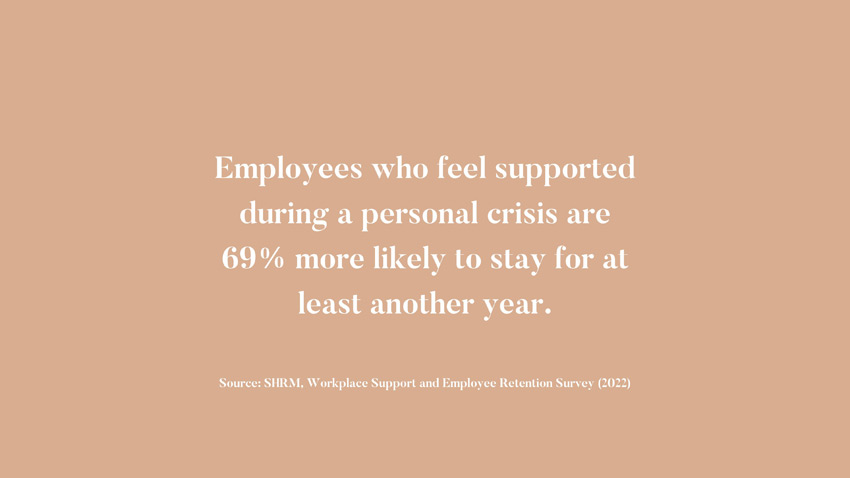
Think counseling sessions, legal and financial consultations, grief or divorce support groups, and curated guides for caregiving. SHRM data shows that employees who feel supported during a personal crisis are 69% more likely to stay for at least another year.4
Do not wait for employees to ask, either — those in situations where they fear they might be judged (divorce is a prime example) often do not want to share at work, but value support being readily available.
4. Normalize Support at Every Level of the Organization
 When leaders share their own experiences such as caring for parents, raising kids and navigating loss, it sends the message that asking for help is not a career killer. It also helps humanize the experience and reduces isolation. When leaders share their own experiences such as caring for parents, raising kids and navigating loss, it sends the message that asking for help is not a career killer. It also helps humanize the experience and reduces isolation.
When You Show Up, They Stay
Do not underestimate the loyalty dividend from helping someone through a personal crisis. A Limeade Institute study in HR Dive found that 60% of employees who felt genuinely cared for planned to stay with their employer for three years or more, compared to just 7% who did not feel that support.5
Retention is not just about salaries or perks; it is about proving, in the moments that matter most, that you value the person as much as the employee. Sarah’s former employer? They have since built a more robust support system for life events, not because of a mandate, but because losing her was a wake-up call. Life happens. Crisis quitting doesn’t have to.
*Names have been changed.
Works Cited
- Family Law Quarterly, Workplace Impact of Divorce (2019).
- MetLife, U.S. Employee Benefit Trends Study (2023).
- Gallup, State of the Global Workplace (2023).
- SHRM, Workplace Support and Employee Retention Survey (2022).
- Limeade Institute, The Science of Care; HR Dive, “Retention soars when employers show workers they care” (2019).
About Forwardly
Forwardly is an all-in-one guide to relationship health, separation,
and divorce, supporting people through life’s hardest
challenges and available as a benefit from leading companies.
 |
RELATED
RESOURCES
You can learn more about
topics such as mental health & wellbeing,
burnout, employee engagement & culture and
more by exploring on-demand webinars in our
HR
Learning Series
and guidance & articles from our HR
Knowledge Center.
|
|
SHARE THIS ARTICLE

|